



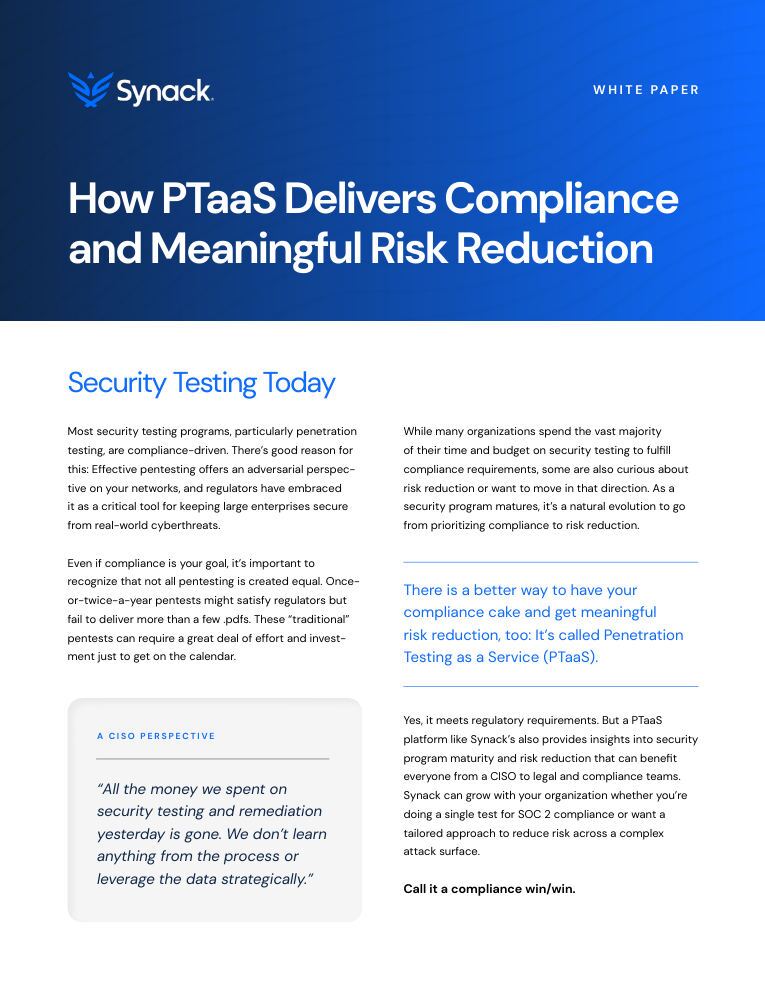
How PTaaS Delivers Compliance and Meaningful Risk Reduction
Most penetration testing programs are compliance-driven, and for good reason: regulators have embraced pentesting as a critical tool for keeping large enterprises secure. But testing only once or twice a year for compliance leaves gaps between tests, and each round takes real effort just to get on the calendar.
This white paper shows how Penetration Testing as a Service (PTaaS) and a clear methodology can align security testing with your budget, goals, priorities and compliance requirements, so the testing you already do for compliance also reduces risk across your attack surface.
PDF, 12 pages. No form required.
What you will learn
Twelve pages on getting more value out of compliance-driven testing.
The deficiencies of traditional testing
Where annual, point-in-time tests leave gaps between audits, and why mature programs add continuous and on-demand testing alongside them.
The challenges PTaaS solves
The priorities security leaders face, from pentest scheduling and re-testing to API security, third-party risk and board reporting.
The stages from compliance to risk reduction
The objectives to set at each phase, from defining scope to centralizing visibility and root cause analytics.
A methodology for asset importance
The questions that determine each asset's criticality, and the testing type and frequency it needs.
Compliance is where most testing starts
For most organizations, security testing is a siloed process required to satisfy compliance requirements like PCI DSS v4.0.1 or GLBA, recommended in frameworks like NIST SP 800-53 and ISO 27001, or mandated for participation in networks like SWIFT. Stakeholders rarely consider how pentesting could improve supply chain security, de-risk acquisitions or harden mission-critical assets.
With a standard vendor, pentests take weeks or months to schedule, there is no easy way to track remediation, and reports are hard to access and share. They do not capture progress, compare improvements across regions or applications, or uncover the root causes of program deficiencies. They may capture the letter of the law for compliance, but not the spirit.
There is a better way to support compliance and get meaningful risk reduction too. A PTaaS platform can support applicable compliance requirements when testing scope, methodology and evidence meet those requirements, and it also gives everyone from the CISO to legal and compliance teams insight into security program maturity, whether you need a single test for SOC 2 or a tailored approach across a complex attack surface. Learn more about compliance penetration testing.
Average time criminals took to exploit newly discovered vulnerabilities in 2023 and 2024, down from 32 days in 2021 and 2022.
Google Cloud Threat Intelligence, October 2024
Why mature programs move beyond traditional testing
Many Synack customers shift to pentesting for risk reduction for these reasons.
Too infrequent
Traditional testing cannot match the rate of change in continuously developed and deployed applications.
Too few skill sets
One or two testers are unlikely to have the diverse skills to find all the flaws in complex application architectures and infrastructure.
Long lead times
Significant lead time before each round of testing leaves vulnerabilities in application updates exposed.
Slow response to critical flaws
It is slow to find and measure the impact of newly discovered critical vulnerabilities, such as the ConnectWise ScreenConnect flaw or the Ivanti VPN exploit chain that allowed remote code execution.
No view of change over time
Standalone reports offer no insight into how security posture is changing over time, across departments or throughout regions.
Hard to operationalize
Results and findings cannot readily be integrated into security operations processes.
Risks a comprehensive testing program helps mitigate
Each priority below involves risks that a comprehensive security testing program can identify and help mitigate.
Average time security teams need to identify the presence of attackers in their network
of security leaders feel unprepared to deal with threats in their cloud environments
of organizations experienced a third-party breach or security incident in the past year
Growth in attacks targeting API vulnerabilities from 2024 to 2025, against 94% for website vulnerabilities
Sources, as cited in the white paper: IBM, Cost of a Data Breach Report 2024; Cloud Security Alliance, The State of Security Remediation 2024; Prevalent, The 2024 Prevalent Third-Party Risk Management Study; Indusface, 2025 State of Application Security.
What a mature testing program looks like
Modern defenders need coverage that spans applications, APIs, infrastructure, clouds, AI technologies, and mobile and endpoint devices. Testing must be performed by a diverse group of testers who can be at least as creative as attackers, often and deeply enough to keep pace with ever-shorter release cycles and ever-more-sophisticated attackers.
Testing results are only one piece of the puzzle. Security teams also need triage to sift through high volumes of testing data and scanner inputs. Synack's testing platform includes tactical and strategic testing, backed by Sara Triage, an AI agent that ingests and prioritizes scanning data with validation from expert human teams.
A mature program makes compliance easier, with a platform to find and fix vulnerabilities and generate reporting well within the windows major regulations require. It also embraces risk reduction, highlighting why weaknesses exist so that root causes can be addressed.
NetSPI and Synack are now one company, pairing deep, point-in-time testing with continuous and on-demand testing. Learn what the NetSPI and Synack merger means for security teams.
Root causes the Synack Platform has uncovered
Detailed findings can set the foundation for your security strategy. These examples from the white paper show what testing data revealed and what changed as a result.
The same vulnerabilities across platforms
80% of vulnerabilities found in applications and infrastructure were authentication-related. A training program on secure authentication reduced the global vulnerability rate by 50% within five months.
Inconsistent remediation across teams
A development team fixed 30% of vulnerabilities on the first attempt and needed three attempts to fix 80%. After the team was retrained, the first-attempt remediation rate rose to 75% within 45 days.
Uneven posture across connected applications
A secure Tier 1 application trusted and ingested data from less secure Tier 2 and Tier 3 applications. The organization redistributed security budget to improve their resilience.
One root cause behind many findings
Consistent host vulnerabilities on separate networks all traced back to the same poorly maintained gold images. Testing data made the business case for investing in new ones.
Stages from compliance to risk reduction
Building a mature security testing program is a process, not a one-time initiative. Define the outcomes you want at each stage, adjusted for your budget, priorities and operations.
Definition
Establish objectives, determine success criteria and determine testing scope.
Compliance
Validate test effectiveness, improve testing and remediation velocity, create a growth plan and report instantly on security posture in line with OWASP, NIST and more.
Compliance and risk reduction
Expand testing to more business units or regions, centralize visibility into results, integrate with DevSecOps and SecOps tooling, and perform consistent root cause analytics and rapid remediation.
Determine how important each asset is
The more critical an asset is to the business, the more often and rigorously it should be tested. For less critical assets, regular automated vulnerability scanning may suffice. Position matters too: an asset in close logical proximity to a business-critical application can still pose a major risk if an attacker could use it as a beachhead to move laterally.
For each application, service or asset in scope, the white paper suggests asking: How much would it cost to recover exposed data if it were compromised? How complex is its code? How heavily is it used, and how prone is it to downtime? Do regulations mandate testing it? Does it process sensitive or confidential data? Is a critical update due within the next year? Would a compromise harm the business's reputation or affect customers?
Match testing type and frequency to each asset
Group applications and assets by criticality, then align testing type and frequency with each group's needs and potential to create risk.
Continuous testing, 24/7/365
Business-critical applications, services and assets.
Continuous testing for 90 days
Seasonal applications, such as those in use during a retailer's busy holiday season, and recently acquired entities or acquisition targets.
Targeted penetration testing
Important applications that do not change frequently, and applications and assets that require pentesting for compliance.
On-demand security testing
When new zero days or widespread, high-risk CVEs may be present in the environment.
For less critical assets, automated vulnerability scanning finds known vulnerabilities on web applications and hosts. Synack's PTaaS platform covers all of these testing types, so you can test assets when, where and how it is needed.
Questions about the white paper
Does PTaaS support compliance requirements?+
PTaaS can support applicable compliance requirements when testing scope, methodology and evidence meet those requirements. A PTaaS platform like Synack's also provides insights into security program maturity and risk reduction, and you can generate on-demand attestation reports for auditors.
Why does re-testing matter for compliance?+
Some frameworks and auditors expect identified vulnerabilities to be fixed and the fixes verified, so check the specific requirements that apply to your organization. Traditional pentesting does not provide a seamless approach for re-testing, while a PTaaS platform lets you re-test fixes on demand.
How often should each asset be tested?+
The more critical an asset is, the more often and rigorously it should be tested. Business-critical applications suit continuous testing, important applications that rarely change suit targeted penetration testing, and less critical assets may need only regular automated vulnerability scanning.
Why move from compliance testing to risk reduction?+
Traditional testing is too infrequent to match the rate of change in continuously deployed applications, and its standalone reports offer no insight into how security posture is changing over time, across departments or throughout regions.
Get the full white paper
How PTaaS Delivers Compliance and Meaningful Risk Reduction. Learn how to rate each asset's criticality, match testing type and frequency to it and move from compliance-only testing to continuous risk reduction. No form. No email required.