

Unifying Security Testing and Exposure Management: Introducing the Synack and Wiz Integration
Security testing and exposure management have run on separate tracks for years, leaving a blind spot between what a scanner flags and what an attacker can exploit. Synack's new integration with Wiz closes that disconnect, feeding continuously validated pentest findings directly into Wiz's exposure management view.

Key Takeaways
- Security testing and exposure management have historically run as separate tracks, leaving a blind spot between what scanners flag and what attackers can exploit.
- A unified CTEM program pairs continuous automated discovery with human-led validation, dividing work by what each side does best.
- Synack's integration with Wiz feeds PTaaS findings with full context directly into Wiz's Penetration Test Findings view.
- The integration is available now at no additional cost to joint Synack and Wiz customers.
Security programs have traditionally run two parallel tracks that rarely talk to each other. One track is exposure management that’s continuous, automated, and maps everything an organization owns. The other is security testing, which includes pentesting and red teaming.
Each track produces its own inventory, its own risk score and its own report. In practice, reconciliation is rare, so the distance between what a scanner flags and what an attacker can exploit becomes a potential blind spot for security teams.
We recognized that gap and partnered with Wiz to design an integration that brings together security testing and exposure management into a single CTEM solution.
Why Do Security Testing and Exposure Management Still Run in Silos?
Vulnerability and exposure management platforms were built to answer “what do we own, and what might be vulnerable.” They excel at scale and cadence. Security testing was built to answer the opposite question: if a skilled adversary tried, what could they do to us? Pentesting and red teaming deliver that judgment, but historically as a point-in-time snapshot that’s disconnected from a team’s exposure management platform.
A test scoped against last quarter’s asset inventory tells you little about risk exposure in a subdomain that spun up last week. And a finding validated by a tester last month has no mechanism for staying current as the environment changes daily.
Exposure management tells you what might be a problem, continuously, at scale, with often too much noise to act on. Testing tells you what’s definitely a problem, with confidence, but only for the testing window.
What Does “Continuous” Mean in Security Testing?
The industry has a name for closing this disconnect: Continuous Threat Exposure Management, or CTEM, the five-stage program structure Gartner introduced to move organizations from periodic assessment to an ongoing cycle of scoping, discovery, prioritization, validation, and mobilization. CTEM is useful less as a product category and more as a diagnostic: it forces the question of whether an organization’s testing and its exposure data are one program in practice.
The stage where that distinction matters most is validation. Discovery and prioritization can be substantially automated. But validating a prioritized exposure requires human judgment. A good pentesting solution will outline the business impact of chaining the exposure with other weaknesses and confirm a fix closes the door. With a unified CTEM program, testing and automated exposure management aren’t replacing one another, they’re simply connected to work back and forth continuously.
Synack and Wiz: A Unified CTEM Solution
Wiz’s new Penetration Test Findings view was built around the premise that pentest results belong alongside the rest of an organization’s exposure data, not in a separate report. It gives offensive security teams a single home for pentest output regardless of where it came from: PTaaS engagements, bug bounty programs, third-party audits, internal red team exercises, Wiz’s own Red Agent, and AI-driven pentest scanning. A security team no longer has to stitch together five different sources to answer what testing found, and whether it’s still open.
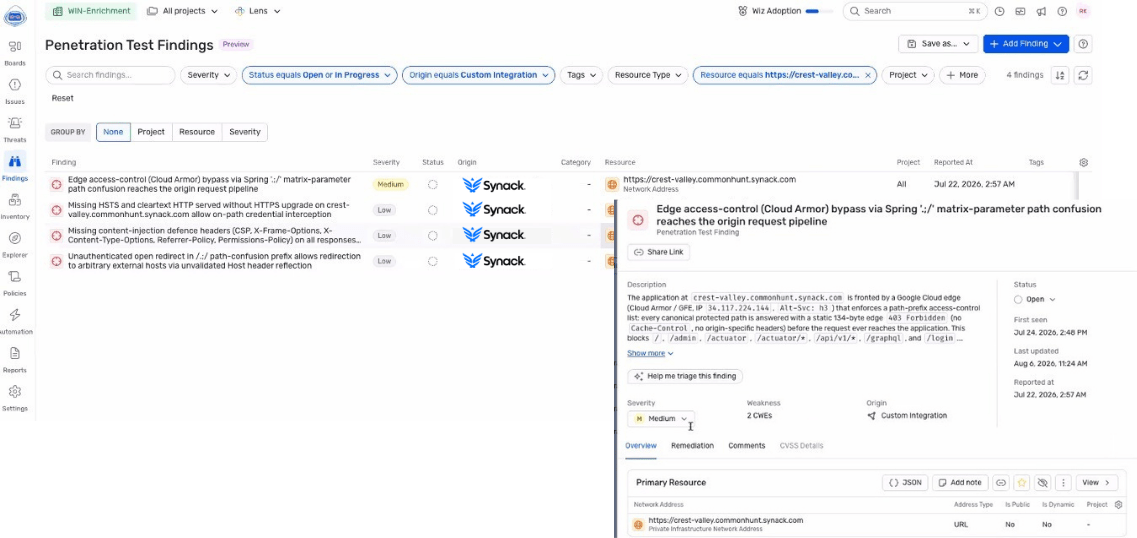
Synack’s integration with Wiz Unified Vulnerability Management is a direct application of that idea. Findings from the Synack’s Platform flow programmatically into Wiz’s Penetration Test Findings view, carrying full context including severity, CWE classification, status, first-seen and last-updated timestamps, and the underlying technical detail a remediation team needs. Synack’s PTaaS platform combines AI-assisted and human-validated pentesting to pinpoint the exploitable risks that matter most.
Because Synack testing runs continuously, and its findings are integrated into Wiz Exposure Management, results go beyond a PDF emailed three weeks ago. They become part of a continuously updated risk picture, alongside the rest of the security landscape the organization tracks in Wiz Unified Vulnerability Management, closing the CTEM loop: validation feeding directly back into discovery, prioritization, and mobilization, in one platform instead of two.
With a unified CTEM platform, the payoff often shows up downstream, in remediation. When testing and exposure data share a workflow instead of two ticketing queues, teams spend less time debating whether a finding is real and more time fixing the ones that are. Organizations that have consolidated this way report meaningfully faster mean time to remediation because the noise separating “flagged” from “confirmed” was finally removed from the critical path.
Get Started with the Synack and Wiz Integration
Synack’s integration is available at no additional charge to existing joint Synack and Wiz customers. To learn more about the partnership between Synack and Wiz, visit synack.com/partners/synack-partners-with-wiz, or contact Synack.
Related reading
Continuous Security Validation: Why It Matters and Why Synack Is Built for It • Attack Surface Discovery and Management: What Security Teams Actually Need to Know • Continuous Penetration Testing: What Security Leaders Need to Know
Synack's Wiz integration
Learn more about how Synack integrates with Wiz so security teams can connect validated pentest findings to the broader context, ownership and remediation workflows they already run in Wiz.
Frequently Asked Questions
CTEM is a five-stage framework, introduced by Gartner, that moves security teams from periodic assessments to an ongoing cycle of scoping, discovery, prioritization, validation, and mobilization. It treats exposure management and security testing as one continuous program rather than two separate efforts.
Findings from Synack’s Penetration Testing as a Service engagements flow programmatically into Wiz’s Penetration Test Findings view, carrying full severity, CWE classification, status, and timestamp data alongside the rest of an organization’s exposure landscape in Wiz Unified Vulnerability Management.
It’s available now, at no additional cost, to existing joint Synack and Wiz customers.
A traditional pentest report is a static, point-in-time snapshot that goes stale as the environment changes. Because Synack testing runs continuously and feeds directly into Wiz, findings stay current rather than describing an environment that existed three weeks ago.
A flagged finding is something a scanner suspects might be a problem. A validated finding has been confirmed exploitable by Synack’s vetted security researchers, often including whether it can be chained with other weaknesses into a more serious attack path.