


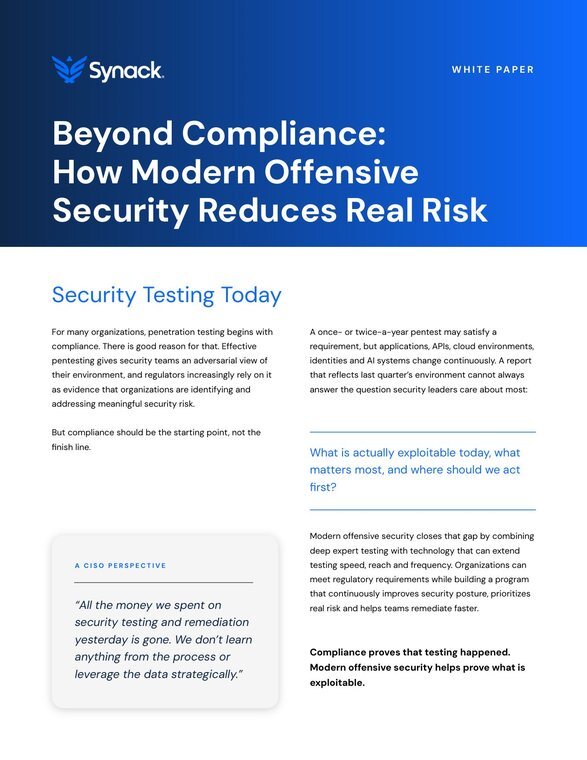
Beyond Compliance: How Modern Offensive Security Reduces Real Risk
Compliance is often where penetration testing begins. But proving that a test happened is different from understanding where your organization is actually exposed.
This white paper shows how security teams can move beyond compliance-driven testing to an offensive security program that identifies exploitable risk, matches testing depth and frequency to the assets that matter most, and turns findings into continuous security improvement.
What you will learn
Twelve pages on building a testing program that answers what is exploitable, not only whether a test was completed.
Move from compliance to real risk reduction
Understand why periodic testing remains important, but cannot provide enough visibility on its own as applications, infrastructure and attack surfaces change.
Match testing to the risk
Learn how to determine which assets need deep expert testing, continuous testing, on-demand validation or broader AI-enabled coverage.
Turn testing data into security intelligence
Use findings over time to identify recurring vulnerabilities, systemic weaknesses and remediation priorities across applications, teams and business units.
Compliance is the baseline. Exploitability is the question.
Penetration testing plays an essential role in compliance and governance. It provides an adversarial view of critical systems and helps demonstrate that security controls are working as intended. But modern security teams need to answer a more important question: what can an attacker actually exploit?
Applications, APIs, cloud services, identities and AI systems can change many times between annual or semiannual assessments. A test performed months ago may still satisfy a requirement, but it cannot always describe today’s exposure.
Modern offensive security extends compliance testing with the flexibility to test at the depth and cadence the risk requires. The goal is not simply more testing. It is greater clarity about what is exploitable, what matters and where to act first.
Why periodic testing alone can leave gaps
Deep, point-in-time penetration testing remains essential. Critical systems often require intensive expert assessment before deployment, after major changes or to meet regulatory requirements.
But point-in-time testing represents a moment. Between those moments applications change, new code reaches production, APIs and identities are added, cloud configurations evolve, third-party dependencies change and new vulnerabilities emerge.
A mature offensive security program therefore combines different testing models rather than forcing every asset into the same schedule. The continuous penetration testing page sets out where each model fits.
Match testing depth and cadence to the risk
Depth when you need it. Continuous when you need it. On demand when you need it.
In depth
Use deep expert penetration testing when systems are business-critical, complex, pre-production or subject to significant regulatory requirements. Expert testers can investigate business logic, authorization boundaries, complex workflows and chained attack paths that require context and creativity.
Continuously
Use continuous testing for important production environments that change frequently and where exposure can emerge between major assessments. Continuous validation gives teams visibility as the environment changes rather than waiting for the next scheduled test.
On demand
Launch testing when an urgent question arises, such as a newly disclosed vulnerability, zero-day, acquisition, critical release or unexpected change in exposure.
Human expertise and agentic AI have different jobs
AI has changed both attack and defense. Agentic AI can expand testing speed, persistence and reach. It is increasingly effective at reconnaissance, enumeration and vulnerabilities with recognizable patterns, which means broader attack surface coverage, faster repeatable testing and higher testing frequency.
But the most consequential risks can hide in business logic, identity boundaries and chained attack paths that require an understanding of how the application or business is supposed to work. That is where human expertise remains essential: testing identity and authorization boundaries, pursuing chained attack paths, validating exploitability and adding the technical and business context that makes a finding actionable.
AI finds the familiar fast. Experts uncover the complex attack paths that require business context. Synack combines agentic AI with expert offensive security testing so organizations can extend coverage while maintaining the judgment and context required to validate real risk.
Turn findings into a stronger security program
The value of testing should not disappear once an individual vulnerability is fixed. Across multiple engagements, testing data can reveal patterns that individual reports cannot: recurring vulnerability classes, inconsistent remediation performance, weaknesses shared across applications, gaps in security controls, business units or regions with concentrated risk, and architectural dependencies that create unexpected attack paths.
Those insights allow organizations to address why vulnerabilities keep appearing, not just remediate each finding independently.
Start with the assets that matter most
Not every application or asset requires the same testing approach. A risk-based offensive security program should consider business criticality, what happens if the asset is compromised, and whether it processes confidential, regulated or customer information.
It should also weigh exposure, meaning how an attacker could reach the asset, and connectivity, meaning whether compromising it would create a path into more critical systems. Rate of change matters too: how often the application, infrastructure or code changes, and how much business logic, identity handling or complex workflow the asset contains. Regulatory requirements may mandate specific testing activities or frequencies.
Together, these factors help determine the appropriate depth, breadth and cadence of testing.
From compliance to continuous risk reduction
A maturity path most organizations travel in stages rather than all at once.
Define
Establish objectives, success criteria, scope and critical assets.
Comply
Perform required testing, validate remediation and maintain evidence for auditors and governance teams.
Expand
Extend testing across more applications, business units and regions. Centralize visibility and integrate findings with security and development workflows.
Reduce risk continuously
Combine deep expert testing, continuous validation, on-demand testing and agentic AI to identify what is exploitable and improve security posture over time.
How Synack supports modern offensive security
Expert depth and AI-enabled scale in one testing program, so coverage expands without giving up the judgment that validates real risk.
Expert depth
Synack Red Team researchers bring specialist offensive security expertise to complex applications, business logic and attack paths.
AI-enabled scale
Sara AI Pentesting extends testing speed and reach, helping organizations assess more of their attack surface more frequently.
One testing program
Centralized findings, remediation workflows, re-testing, reporting and integrations help teams move from individual engagements toward an ongoing view of exploitable risk. Penetration Testing as a Service (PTaaS) remains an important delivery model within this, supporting deep, continuous and on-demand testing.
Questions about the white paper
What is the difference between compliance testing and risk-based penetration testing?+
Compliance testing helps demonstrate that required security assessments have been completed. Risk-based penetration testing goes further by considering asset criticality, exposure, business impact and exploitability to determine where testing should be deepest and most frequent.
Does continuous penetration testing replace traditional pentesting?+
No. Deep point-in-time penetration testing remains valuable for critical systems, pre-production testing and regulatory requirements. Continuous testing complements it by providing visibility as production environments change between major assessments.
How should organizations decide how often to pentest?+
Testing frequency should reflect the asset’s business importance, exposure, rate of change, regulatory requirements and the potential impact of compromise. Critical and rapidly changing systems generally require more frequent validation.
Where does agentic AI fit into penetration testing?+
Agentic AI can accelerate reconnaissance, repeatable testing and discovery of recognizable vulnerability patterns. Expert testers provide context, creativity and validation for complex business logic, identity boundaries and chained attack paths. The AI pentesting page covers how Synack combines the two.
How can penetration testing help reduce risk beyond compliance?+
Testing data accumulated over time can reveal recurring vulnerability classes, inconsistent remediation, architectural weaknesses and areas where security investment should be prioritized. The continuous pentesting demo walks through how findings move from discovery to proof.
Get the full white paper
Beyond Compliance: How Modern Offensive Security Reduces Real Risk. Learn how to move from compliance-driven testing toward an offensive security program that matches testing depth and frequency to risk, combines expert judgment with agentic AI, and turns findings into continuous security improvement. No form. No email required.