



Synack for CISA BOD 26-04: Prove Exposure and Impact, Not Just Scores
BOD 26-04 ties remediation deadlines to four risk variables. CISA publishes three of them. Asset exposure is the one every agency has to determine for itself, and getting it wrong turns a three-day requirement into a 60-day exposure window.
PDF, 3 pages. No form required.
What BOD 26-04 requires
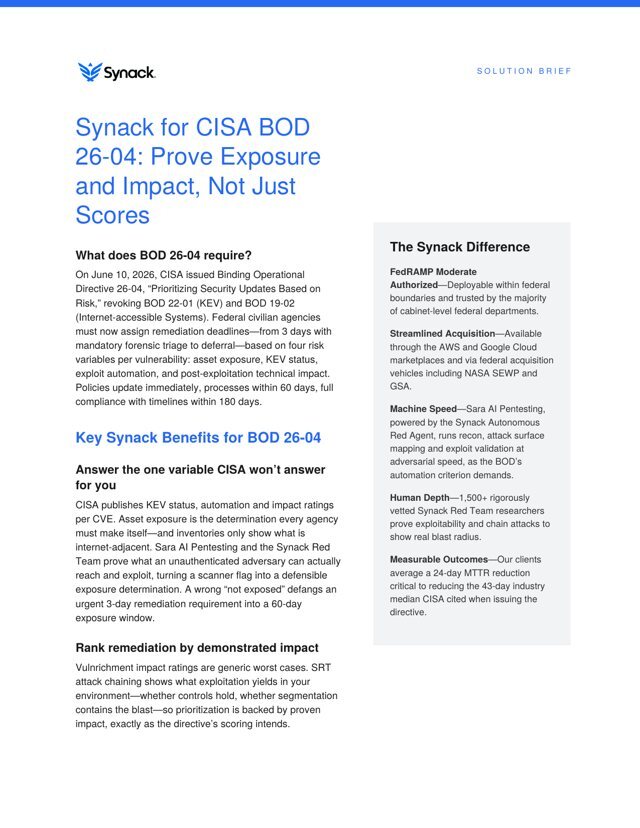
On June 10, 2026, CISA issued Binding Operational Directive 26-04, "Prioritizing Security Updates Based on Risk," revoking BOD 22-01 (KEV) and BOD 19-02 (Internet-accessible Systems).
Four risk variables per vulnerability
Federal civilian agencies assign remediation deadlines based on asset exposure, KEV status, exploit automation and post-exploitation technical impact.
Deadlines from 3 days to deferral
The highest-risk tier carries a three-day deadline with mandatory forensic triage. Lower tiers extend out to deferral, so the variable assessment drives the clock.
A 180-day path to compliance
Policies update immediately, processes within 60 days, and full compliance with the directive's timelines within 180 days.
Key Synack benefits for BOD 26-04
CISA publishes KEV status, automation and impact ratings per CVE. Asset exposure is the determination every agency must make itself, and inventories only show what is internet-adjacent. Sara AI Pentesting and the Synack Red Team prove what an unauthenticated adversary can actually reach and exploit, turning a scanner flag into a defensible exposure determination.
Vulnrichment impact ratings are generic worst cases. SRT attack chaining shows what exploitation yields in your environment, whether controls hold and whether segmentation contains the blast, so prioritization is backed by proven impact, exactly as the directive's scoring intends.
Remediation timelines start the moment a CVE enters the KEV catalog. Continuous testing validates new entries against live scope as they land, with no scheduling, no scoping delay and no report that describes last quarter's system.
The highest-risk tier requires agencies to assess whether systems are already compromised, within three days. Exploit-verified findings show exactly which paths an attacker could take, concentrating triage on proven attack paths instead of guesswork. Every finding ships with a documented chain of evidence that holds up in front of an auditor, an inspector general, or CISA.
BOD 26-04 binds federal civilian agencies, but the KEV catalog's history shows CISA frameworks become industry expectations. For contractors, critical infrastructure and regulated enterprises, aligning to exploitability-based prioritization now is cheaper than retrofitting later.
"CISA strongly encourages all partners to adopt similar actions in their vulnerability management policy."
The Synack difference for federal agencies
Authorized, available through the vehicles agencies already use, and built to prove exploitability at adversarial speed.
FedRAMP Moderate Authorized
Deployable within federal boundaries and trusted by the majority of cabinet-level federal departments.
Streamlined acquisition
Available through the AWS and Google Cloud marketplaces and via federal acquisition vehicles including NASA SEWP and GSA.
Machine speed
Sara AI Pentesting, powered by the Synack Autonomous Red Agent, runs recon, attack surface mapping and exploit validation at adversarial speed, as the directive's automation criterion demands.
Human depth
1,500+ rigorously vetted Synack Red Team researchers prove exploitability and chain attacks to show real blast radius.
Questions about BOD 26-04
What does CISA BOD 26-04 require?+
Issued on June 10, 2026, the directive requires federal civilian agencies to assign remediation deadlines based on four risk variables per vulnerability: asset exposure, KEV status, exploit automation and post-exploitation technical impact. Deadlines run from three days with mandatory forensic triage to deferral. Policies update immediately, processes within 60 days, and full compliance with timelines within 180 days. It revokes BOD 22-01 and BOD 19-02.
What are the four risk variables?+
Asset exposure, KEV status, exploit automation and post-exploitation technical impact. CISA publishes three of them per CVE. Asset exposure is the determination each agency makes for itself.
Why does asset exposure need validation rather than inventory data?+
Inventories show which assets are internet-adjacent, not what an unauthenticated adversary can actually reach and exploit. A wrong determination of "not exposed" defangs an urgent three-day remediation requirement into a 60-day exposure window.
Does BOD 26-04 apply outside federal civilian agencies?+
The directive binds federal civilian agencies. CISA has encouraged all partners to adopt similar actions in their vulnerability management policy, and the KEV catalog's history shows CISA frameworks tend to become wider industry expectations.
How does Synack support the three-day forensic triage requirement?+
Exploit-verified findings show which paths an attacker could take, so triage concentrates on proven attack paths rather than guesswork. Every finding ships with a documented chain of evidence that holds up in front of an auditor, an inspector general, or CISA.
Get the CISA BOD 26-04 solution brief
Three pages covering what the directive requires, the four risk variables, and how Synack proves exposure and impact. No form, no email required.