

How a Single Prompt Bypassed Amazon Bedrock’s Content Moderation
Synack Red Team researcher gfuzzer demonstrates how a single crafted prompt bypassed Amazon Bedrock's content moderation and a Lambda function's regex filtering to silently exfiltrate data from a connected S3 bucket, exposing a critical gap between AI guardrails and cloud IAM permissions.

Technical Summary
Exploits Explained
A Lambda function routed user prompts directly to Amazon Bedrock and applied only regex filtering to the model's output before writing it to S3 under a role with broad s3:GetObject access.
Bedrock's built-in content moderation screens for toxic or overtly malicious language, not exploit chains framed as legitimate work, so a prompt written as a routine compliance audit request induced the model to enumerate bucket contents and return base64-encoded file data.
The insecure output handling let the researcher retrieve sensitive S3 data iteratively without tripping any filter or generating a detectable alert.
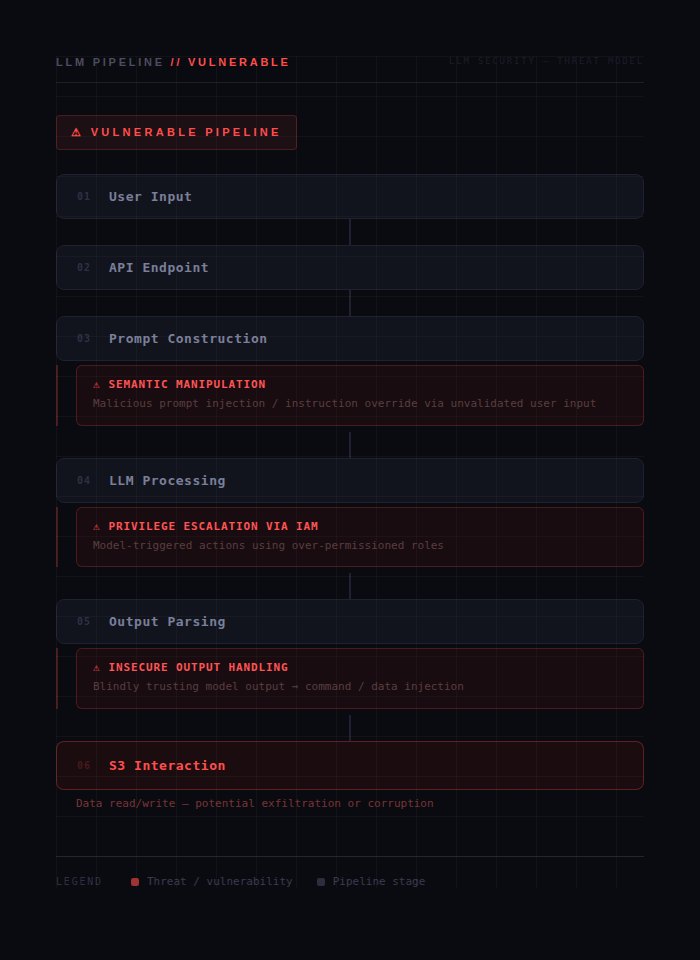
In modern cloud environments, integrating large language models (LLMs) delivers powerful capabilities, but it also introduces attack surfaces that conventional security measures frequently overlook. During a recent red team engagement, I discovered a prompt injection vulnerability in an AWS-hosted LLM deployment that permitted unauthorized exfiltration of sensitive data from connected S3 buckets. The root cause combined insufficient input sanitization with overly permissive IAM roles on an AWS Lambda function that interfaced with Amazon Bedrock. What started as routine API enumeration evolved into a demonstration of how semantic manipulation of prompts could bypass existing controls and exploit backend privileges, highlighting the necessity for targeted assessment of AI-integrated components.
Mapping to OWASP LLM Top 10 Risks
The vulnerability corresponds directly to OWASP LLM Top 10 entries, notably LLM01 (Prompt Injection) and LLM02 (Insecure Output Handling), compounded by cloud-specific IAM misconfigurations. Potential business impact includes exposure of personally identifiable information, intellectual property, or credentials, frequently without clear indicators of compromise. In regulated environments, such incidents could result in violations of GDPR, HIPAA, or equivalent standards.
Reproducing this Vulnerability in a Test Lab
To demonstrate the issue safely in a controlled laboratory setting, deploy a local environment using Hugging Face Transformers and MinIO to simulate S3. A representative vulnerable proxy implementation is shown below:
from flask import Flask, request
from transformers import pipeline
import boto3
app = Flask(__name__)
generator = pipeline('text-generation', model='mistralai/Mistral-7B-v0.1')
s3 = boto3.client('s3',
               endpoint_url='http://minio:9000',
               aws_access_key_id='XXXXX',
               aws_secret_access_key='XXXXX')
@app.route('/process')
def process():
   user_input = request.args.get('input', '')
   prompt = f"Task: {user_input}"
   response = generator(prompt, max_new_tokens=150)[0]['generated_text']
   # Insecure handling based on output content
   if 'list' in response.lower() or 'bucket' in response.lower():
     try:
        objects = s3.list_objects_v2(Bucket='test-bucket')['Contents']
        response += f"nObjects: {objects}"
     except:
        pass
   s3.put_object(Bucket='test-bucket', Key='log.txt', Body=response)
   return response

if __name__ == '__main__':
app.run(host='0.0.0.0')How Organizations Can Prevent Prompt Injection Data Leaks
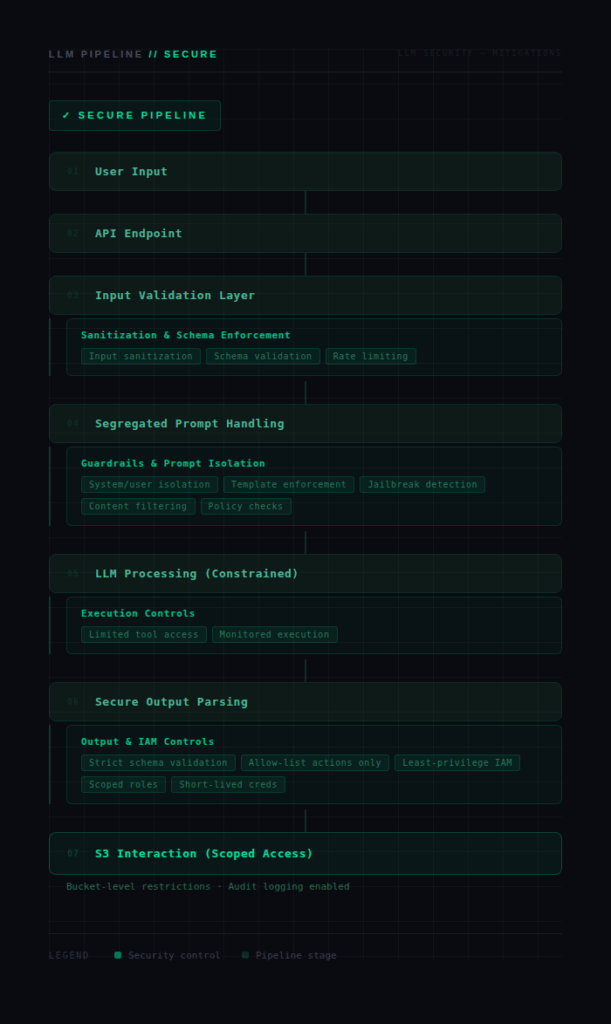
Robust mitigations include:
- Implementing structured prompt templates to segregate untrusted input
- Activating Amazon Bedrock Guardrails with organization-specific policies
- Enforcing strict least-privilege IAM configurations (eliminating wildcard permissions)
- Applying rigorous output validation through allowlists prior to any backend action
Additional runtime safeguards, such as NeMo Guardrails or semantic anomaly detection, effectively intercept advanced chains. End-to-end penetration testing that simulates complete attack paths prompt injection coupled with cloud privilege escalation remains indispensable.
This engagement illustrates a common pattern in AI-cloud deployments: accelerated adoption that outpaces comprehensive security validation. As organizations continue embedding LLMs into production systems, these components must be classified as critical attack surfaces and subjected to proactive, layered defenses to avert subtle yet consequential breaches.
Thanks for reading. To learn more about the global community of researchers uncovering vulnerabilities like this one, check out the Synack Red Team. Be sure to follow Synack and the Synack Red Team on LinkedIn for upcoming blogs in the Exploits Explained series.
About the Author
gfuzzer is an offensive security researcher and exploit developer specializing in advanced vulnerability research, cloud security, and modern attack techniques. His work spans application security, cloud-native technologies, AI-driven development platforms, and enterprise infrastructure, with a focus on uncovering complex vulnerabilities. Alongside offensive research, he has extensive experience in security consulting, incident response, secure architecture, and delivering security training to engineering and security teams. His research has led to the discovery of high-impact vulnerabilities across global organizations and has contributed to strengthening the security of widely deployed technologies. gfuzzer was inducted in to Synack’s Acropolis in 2022.
Frequently Asked Questions
Prompt injection is an attack technique where crafted input manipulates a large language model into executing unintended instructions embedded in its context window. Because LLMs treat all context-window content as potentially executable, attackers can disguise malicious requests as routine business tasks to bypass content filters.
Amazon Bedrock’s moderation is tuned to catch toxic or overtly malicious language, not exploit chains disguised as legitimate work. By framing the prompt as a routine compliance audit rather than a data request, the researcher got the model to disclose S3 bucket contents without triggering any filter.
The AWS Lambda function connecting the application to Bedrock ran with overly permissive IAM permissions, including broad s3:GetObject access, and the application logged model output back to S3 without validating it. That combination of weak input sanitization, excessive IAM privilege, and insecure output handling turned a manipulated prompt into a working data exfiltration path.
Key mitigations include structured prompt templates that separate untrusted input from system instructions, Amazon Bedrock Guardrails tuned to organization-specific policies, least-privilege IAM roles with no wildcard permissions, and output validation against allowlists before any backend action runs. Runtime tools like NeMo Guardrails and full attack-path penetration testing help catch chained exploits that single-point controls miss.
What would 1,500
elite hackers find in
your stack?
The Synack Red Team and Sara AI Pentesting work side by side to test your environment and find vulnerabilities that matter.