
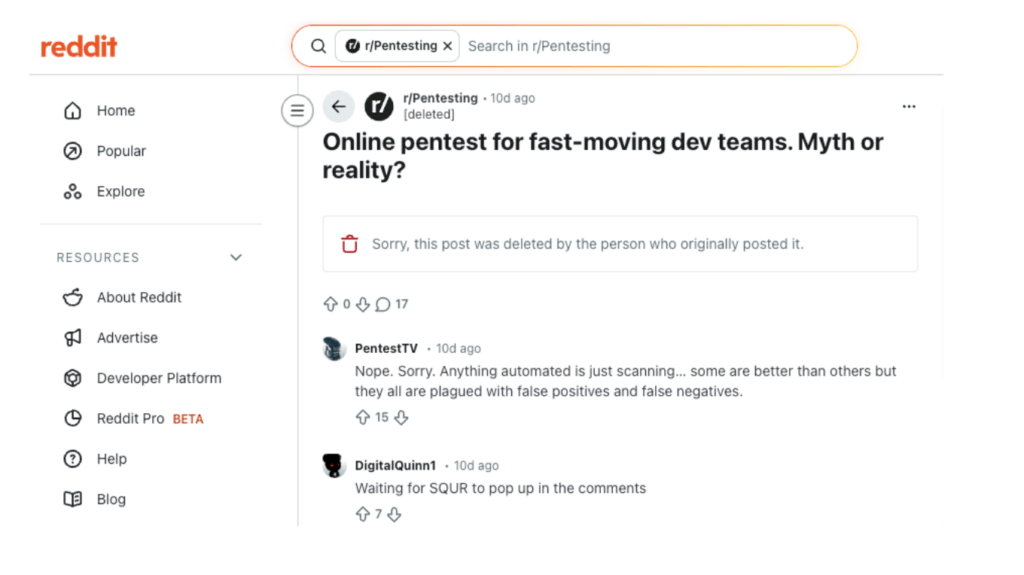
In the world of high-velocity CI/CD pipelines and “ship it yesterday” mentalities, penetration testing is often viewed as the ultimate speed bump. I recently came across a Reddit thread discussing whether “online” or automated pentesting is a myth for fast-moving teams, and it sparked a necessary conversation for us as security engineers.
Security engineers are often caught between two worlds: the need to maintain a rigorous security posture and the reality of development teams that deploy as much as 50 times a day. If you’re feeling the “pentest vs. velocity” friction, here’s why we need to stop treating pentesting as a checkbox and start treating it as a specialized engineering feedback loop.
The Myth of “Automation Only”
One of the most poignant takeaways from the Reddit discussion is that vulnerability scans are not pentests. In a fast-moving environment, there is a massive temptation to rely solely on DAST/SAST tools integrated into the pipeline.
While these are essential for catching low-hanging fruit—acting as an automated safety net—they are notoriously bad at catching logical flaws, privilege escalation paths, and complex chain-attacks. To move beyond just “filtering the noise,” we need evolve how we use our human capital:
- Automation for Volume: Let the tools handle the repetitive, known-signature vulnerabilities.
- Human-Led Logic: If a manual pentest uncovers a flaw that could have been caught by a tool, the remediation task must include updating the automated scanner’s ruleset. This ensures the human is always pushing the automation to be smarter, rather than repeating its work.
As one Redditor noted: “We caught a priv esc path last week that appeared between deploys and no scanner would have flagged it”. For a security engineer, this is the core value of a pentest. Tools see the code; humans see the intent and the gaps between the services.
Why Fast Teams Need Humans in the Loop
When development moves fast, “environment drift” happens at lightning speed. A manual pentest provides three things that your CI/CD pipeline can’t:
- Contextual Risk Assessment: A scanner will flag a “medium” vulnerability based on a CVSS score. A pentester will tell you that the “medium” is actually a “critical” because it sits right next to your PII database.
- Creative Edge Cases: Fast-moving teams often rely on boilerplate or modular code. Pentesters look for the “seams” between those modules where business logic breaks down.
- Proof of Concept (PoC): As discussed in the thread, the biggest hurdle for getting devs to care is the language barrier. A pentest report that includes a PoC is a “show, don’t tell” moment. It transforms an abstract security requirement into a tangible vulnerability that needs fixing.
Moving from “Gatekeeper” to “Enabler”
If we want pentesting to work for fast teams, we have to change the delivery model. The “throw the report over the fence” method is dead. Here is how we, as security engineers, should be pitching pentesting to our stakeholders:
- Continuous Pentesting: Instead of one massive annual pentest, move toward “Continuous Pentesting” or periodic “Micro-tests” on specific high-risk features. To maintain velocity, establish Trigger Criteria. A human pentester should be engaged when:
- There are changes to authentication or authorization logic.
- New third-party APIs or PII-handling services are integrated.
- Structural changes occur in the network architecture.
- DevSecOps Influence: Don’t just find holes; work with the Platform or SRE teams to build the correlation rules in your SIEM/SOAR so that if that specific exploit is attempted again, it’s caught automatically. To provide value, track success metrics (KPIs):
- MTTR (Mean Time to Remediation): Understanding the efficiency of remediation processes.
- Vulnerability Density: The number of security flaws per thousand lines of code (KLOC), provides a standardized measure of code quality.
- Deployment Frequency: Ensuring security checks do not become a bottleneck for shipping value.
- Speak the Language of Business: As one commenter wisely pointed out, if you want buy-in, don’t just say “this enhances security.” You need to frame it in terms of cost-avoidance. Say: “This tool/process will help us build faster because it identifies systemic issues early, preventing emergency ‘drop everything’ patches that derail our roadmap later.”
Pentesting in a fast-moving team isn’t about slowing down the release; it’s about ensuring that the speed doesn’t lead us off a cliff. As security engineers, our job isn’t just to find the vulnerabilities—it’s to translate those findings into actionable engineering tasks that fit into a modern sprint.
A human, creative pentest remains the most effective way to validate that our automated “safety nets” are actually catching what they’re supposed to.
What’s your take? Are you finding success with Breach and Attack Simulation (BAS) tools, or is the manual pentest still your gold standard?